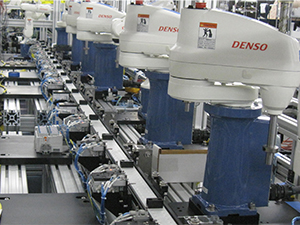
Contract manufacturing is a commonly used outsourcing model employed by companies – from start-ups to tech behemoths like Apple – to scale production and reduce overhead.
But despite its ubiquitous role in the modern supply chain, contract manufacturing remains widely misunderstood and is a source of frequent disappointment for companies that rush into it without a solid understanding of what a contract manufacturer can – and can’t – do.
While contract manufacturing can provide a cost-effective way around scaling obstacles, it’s not the right fit for every project and when it’s wrong, it’s often really wrong – with results that quickly reverse any cost savings.
The key is in understanding the pros and cons of contract manufacturing, not in a broad sense, but as they specifically relate to your project. What are the advantages and disadvantages of contract manufacturing? That’s the wrong question. What you need to know is whether your project is the right fit for a process that fails when it isn’t – and what you can do instead.
Advantages: When Is Contract Manufacturing a Good Option?
There are many reasons a company may seek to outsource part or all of their manufacturing processes to a contract manufacturer.
Contract manufacturers make it possible for companies with limited means or an overwhelming workload to outsource the manufacturing of products. They can provide specialized, technical manufacturing insights for companies that lack the internal resources or want to scale up faster than they can on their own. There may be cost savings. Some companies seek contract manufacturers to manage fluctuating demand that would otherwise require them to continually scale up and down. Others seek out contract manufacturing to free up their capability to focus on innovation and the next big product.
They’re all valid reasons for seeking a contract manufacturer, sometimes referred to as the “build-to-print” option. When the project is a good fit, contract manufacturers can create more opportunities for companies with emerging technologies.
Is Your Project Ready for Contract Manufacturing?
NOTE: Contract manufacturers will build exactly to the prints you provide and do not take responsibility for issues with your design or documentation, often lacking the engineering expertise to do so.
Typical contract manufacturers require precise documentation with detailed assembly instructions. They will build exactly to the prints you provide and do not take responsibility for issues with your design or documentation.
This can create problems and misalignment if your documentation is incomplete or inaccurate or if you need improvements to your product. For these situations you may consider outsourcing to manufacturers who have design capabilities or delay outsourcing until your design is fully mature.
For a step-by-step guide on how to select a custom manufacturing equipment supplier, click here.
Disadvantages: Why Contract Manufacturing Projects Fail
You will often hear talk of things like losing control of your process or the risk of having intellectual property leaked as among the disadvantages of contract manufacturing. And while such risks are real, we find that contract manufacturing projects are more likely to fail as a result of not sharing enough information.
One of the biggest misconceptions around contract manufacturing and build-to-print, is that any designed project can simply be handed off with some drawings and documentation.
Contract manufacturers are good at manufacturing from detailed and perfectly clean documentation and specs; unless your project requires minimal assembly, anything less is likely to end in failure.
And even the most well-designed prototypes and products are often lacking in the documentation needed to ensure accurate replication.
Incomplete Documentation
Many companies underestimate the degree to which the specifications and material details are locked away inside the brains of their PhDs – as opposed to being on record in a format that an outside manufacturer can follow precisely.
Engineers may have put a tool together, tweak it, buy parts from the local hardware store and do creative things to make it work that never become part of the documentation.
It’s not enough to have a tool that works – it has to work consistently from tool to tool. If the maturity of your design and documentation is not up to the level required to achieve that, including a complete bill of materials, drawings and assembly instructions, contract manufacturing is a poor option.
Other reasons build-to-print contract manufacturing projects fail include:
- Changes from previous builds not captured
- Significant improvement required
- Complicated assembly or test required
- No design engineering support from the contract manufacturer
The Alternative: Build-to-Spec Outsourcing
For projects that don’t meet the criteria for successful contract manufacturing, you may benefit from an outsourced manufacturing provider experienced in highly complex, unique and specialized equipment builds that include design services, sometimes referred to as “build-to-spec.”
While contract manufacturing puts the responsibility for specifications onto the customer, build-to-spec manufacturing encompasses both needed design improvements and the completion of any missing documentation.
By outsourcing both the design and manufacturing to suppliers who have expertise in both, you can improve design efficiency and product quality with a seamless transition to production, for faster time to market.
The Advantage of a Partner who Specializes in Difficult-to-Outsource Projects
At Owens Design, we specialize in difficult-to-outsource (DtO) projects where significant manufacturing and engineering challenges make ordinary contract manufacturing a risky undertaking. Our team includes highly experienced engineers and manufacturing specialists with a long track record of innovative solutions for complex manufacturing across industries.
For help in identifying the right outsourcing solution for your complex manufacturing needs, reach out to Owens Design today.
