Author: Mark Turner, PhD, Turner Laser Systems
In the previous blog, we explored how to choose the right partner to support your process and integration needs at the very early stage of discovering lasers as a potential solution to your product development or manufacturing needs.
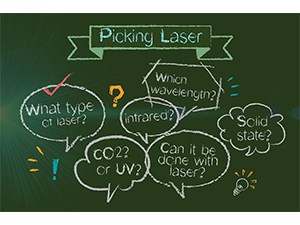
In this blog, we cover one of the most common and important questions that we get asked all the time: “What’s the right type of laser for my application?”
This question is asked in many different ways:
- What type of laser is best to be used?
- Should we use CO2, UV or infrared laser?
- Should we use a fiber laser or a solid state laser?
- Can it be done with the laser?
One of the biggest challenges when people are trying to address this question is knowing the best approach to this question. This early laser feasibility stage is referred to as Phase One. There are steps on how to approach this methodically but this blog focuses first on the three common mistakes that people make time and time and again. These missteps, though unintentional, can cost companies a lot of money and waste a lot of resources, which ultimately lead to major delays as well into product development and/or manufacturing — sometimes by years if this isn’t approached in the right way. And for startups, these mistakes can result in your never leaving the laser valley of death…
Mistake #1: Not Being Transparent
While it’s important to protect your IP, it’s important for the laser expert to have a full understanding of your application, even at a high level. Laser experts or engineers can best solve your production problem, your manufacturing problem, or your product development problem when they understand clearly how the problem fits into your product, the reason for the process, the purpose of the feature and how everything affects your product – the big picture. A good laser applications engineer should then be able to translate these high-level requirements and information you provide into a process specification, and that in turn will translate to developing the actual process that serves your needs.
At this early stage, it’s important to be open minded and creative in your thinking of a solution. It’s also critical for you and the laser applications engineer to take the time to educate each other. Doing this can save a lot of time from boxing yourself into an inefficient solution right from the start or coming to the wrong conclusion based on incorrect assumptions.
When we receive very specific process specifications from customers – let’s say a specific feature with “this much” tolerance or it has to be “this exact” throughput etc. – we often challenge this and ask for the big picture because we need to make sure there’s an alignment between the process specification and the intention of the process.
An example would be a frequent request for chamfers to remove edge defects for the purpose of improving the mechanical strength of a CNC machined part. However, in laser processing, sometimes (not always) a chamfer can be skipped because laser cutting can have a quality that’s good enough to not require post-processing. In this example, the education between the two parties can help determine if a chamfer is necessary.
There are many other examples of technical specifications, such as tapering of certain features. Typically, laser cutting, ablation, and drilling methods have a sort of taper angle to them. With some education to the customer early on, a laser application engineer can help them understand different types of limitations to the various manufacturing processes. You can in turn educate the laser expert on the true needs for the application. This production exchange can then help determine the degree of tapering appropriate for the application.
Mistake #2: Shooting in the Dark
Another common mistake is trying out different lasers randomly without any deep thought or understanding about what laser was chosen, how it was used, and what you learned from initial testing.
A good example here is that you go to shops A, B and C to test their different types of lasers. You may not know exactly what type of laser it is or how the lasers are set up. And you get:
- Bad result from Shop A
- Bad result from Shop B
- OK result from Shop C
At that point, you have not gained a clear understanding on what works and what doesn’t, and why bad results vs OK results, or even how to get better results. All you know is that in Shop C, they got an OK result, but you don’t know how it’s going to translate.
The main lesson: process development takes time. The main thing to remember here is that just because one test, one supplier, or one laser may be a complete failure—maybe even sets your part on fire—doesn’t mean there is no hope for a different laser out there to be the perfect tool for your application.
Mistake #3: Not Doing Enough Homework
A frequent mistake that isn’t talked about enough is the urge to draw a conclusion before enough work is done.
People often want simple answers asking, “is this the right laser for the job?” and an expert will reply, “it depends.” Laser process development is complex and it’s important to refrain from jumping to conclusions on whether a laser is the right one without understanding the difference between the fundamental laser-material interaction, which is typically related to the laser type and the laser process, which in turn is related to how that laser is being utilized. Often the right laser doesn’t seem to be doing the right job until the correct parameters are dialed in, and determining them requires a laser expert.
For example, you can have a $1M state-of-the-art, ultrafast laser machine and your material could still catch on fire even though you’ve invested in this very fancy and advanced laser tool. You may then want to determine that this is the wrong laser for the job, but it’s important to refrain from judgement, as the devil is in the details. Laser systems, especially micromachining laser systems with pulsed lasers, have a lot of adjustment capabilities. There are many knobs, dials and parameters that you can adjust that the process space is actually extremely vast.
For example, we’ve spent 100 hours on an application dialing these knobs, trying out different configurations, and every single part came out looking absolutely horrendous. It wasn’t until hour number 101 when we started to get a result that looked like the solution was viable. Sometimes we can get contrastingly different results just by adjusting these parameters in finding the right process regime. Of course, it’s not always that long and tedious. Sometimes we run applications where after 30 minutes we’ve hit the bull’s eye. So, it really depends on the application and the complexities of the process and the materials.
What It All Means
In summary, to avoid these common mistakes, remember that good process development requires expertise in the field, deliberation, and persistence to be successful: tests should be well-designed and purposeful to fit the big picture, so that findings can be meaningful as learnings, and a process to be developed methodically with persistence for the right result.
Of course, avoiding mistakes is just the start. In the next blog, you’ll find steps used to select the right type of laser.
Contact us to learn more about custom lasers
Article reprinted with permission from our partner Turner Laser Systems
