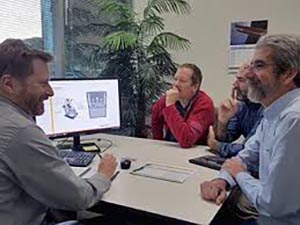
When speaking with engineering managers, the complaint is always the same: “There’s no way we can get all of our work done with the resources I have!”
The reasons vary: hiring freezes, resources tied up supporting existing products, resolving problems with the last new product, and, simply, too many projects. The two constants: customers have endless requests and the company needs new products to grow.
This blog discusses three traditional methods of adding engineering and manufacturing resources: one where you assume all risk, one where you assume most of the risk, and one where your partner shares the risk with you, which has successfully been used at many innovative manufacturers.
Contracting
Contracting is essentially the same as hiring, except that there is no promise of permanent employment. You provide the tools, training, supervision, and take responsibility for the work output. If the contractor does it wrong, you have to find a new contractor or pay him to do it again.
With a contractor, you agree to a number of hours a week and pay them for it whether you keep them busy or not. Contracting tends to work well for longer term, full-time assignments where you can hire the talent. It can also be a great way to try someone out before you hire them permanently.
Consulting
In contrast, consultants provide their own tools, perform most of their work offsite, do not require close supervision, and usually take responsibility for their work. If they do it wrong, they will usually fix it on their own time. Most consulting is done on an hourly basis, so you pay only for the time they are working on your project.
While the consultant takes more responsibility than the contractor, you still bear most of the risk. Conflicting motivations – such as minimizing scope creep – can be a huge problem for you but is often an acceptable outcome for the consultant as it results in more billable hours.
Regardless, engaging consultants is a great way to access talented people in specialized technical areas for occasional needs. Any development group should have a set of core consultants identified for your staff to draw upon when the need arises.
Collaborative Development
An emerging model is collaborative development, which is fundamentally different from contracting and consulting because the risk is shared much more equally between the individuals and companies involved.
Also referred to as open innovation, collaborative development recognizes that not all smart people work inside your company. When Proctor & Gamble studied sources of innovation in their company as profiled in the Harvard Business Review Article, How P&G Tripled Its Innovation Success Rate, they discovered that there were 200 equally talented scientists or engineers working elsewhere in the world for every one P&G employee. This suggests there are over 1.5 million people P&G could potentially draw upon for new products, manufacturing processes, and materials to reach even higher levels of innovation.
In contrast to consulting and contracting, collaborative development requires a strategic approach and long-term perspective. To be effective, collaborative development should be addressed from a product or company roadmap perspective. Which areas do you want your development team to focus on and which could be done with a partner? Most companies at this point have identified their core competencies, so the question is: what additional technologies, know-how, and skill sets are needed for your product line to be successful? This usually provides a starting point when looking for partners.
Speed Dating Doesn’t Work
Finding a suitable collaborative development partner is challenging. You need to find a company that match both technical and business needs. While you may start the search with one set of criteria, it’s likely that your criteria will evolve as you better understand your potential partner’s capabilities. This process should not be rushed, or a poor decision will likely be made.
Once a collaborative partner is found, it’s essential to have senior management support and involvement to further the relationship. There are many partnership and business issues, such as intellectual property protection and supply agreements, which must be agreed upon. Without the support of senior management, these issues may derail the process.
Finally, a collaborative development relationship is like any long-term relationship because it will take effort and attention to bear fruit. Achieving and maintaining business alignment is a continuous process. Regular discussions of the product roadmap, market conditions, and business goals are necessary. Senior management participation is also extremely important to keep the relationship aligned with overall company goals.
Your Collaborative Development Partner for Design & Manufacturing
Collaborative development requires commitment and the willingness to adjust your perspective on traditional design resources. Properly executed, this emerging method of partnering can expand your resources and minimize development risk.
If you’d like to expand your design, engineering and manufacturing resources while minimizing your development risk, speak with the Owens Design team. For the past 40 years, OEMs and manufacturers seeking factory automation have relied on Owens Design as an extension of their engineering and manufacturing teams to deliver innovative solutions in record time.
